Tuesday, May 22, 2012

Chen Xiaowang: Five Levels of Taijiquan

Grandmaster Chen Xiaowang
Over the last several years I have read many books on taijiquan. Some are very basic and explain the forms in an elementary and "outward" way. I have found these useful, in a limited way. Some are of the type,"This is the best taijiquan style and all others are fake." These are less than useful. Still others are written by masters and have a depth that requires reading and re-reading. Each time something new is discovered as your own practice evolves.
Grandmaster Chen Xiaowang's The Five Level of Taijiquan with a commentary by Master Jan Silberstorff, is of this type. It a fairly brief text, but is a useful guide as to where your taiji is at present, from the vantage point of where it might be in the future, from someone who is already there.
In brief, Chen Xiaowang suggests that ninety-nine percent of taiji players are in the first level of taiji development. The one percent are at level two and upward, with fewer and fewer in the higher levels.
I tried to be as objective as I could and after over a thousand hours of taiji, I would place myself at the juncture between levels one and two. By the end of level one a student has learned the form (of whichever style the student practices), has a reasonable body alignment, and some beginnings of an understanding of the philosophy —not merely "head" knowledge, but an integral mind-body knowledge. Reading through the Grandmaster's levels, I have a long way to go!
It did give me a way of looking at the levels of progress I designed for students of Way of Peace Taijiquan. My intent was to give students, who take taiji seriously a way of marking their progress in daily practice. I determined that hours practicing were a more accurate measure than number of forms learned. Progress is marked more quickly early in taiji, becoming increasingly difficult as proficiency is acquired. I estimated that if a student was conscientious and practiced for half an hour each day if would take between five and six years to complete the first twelve levels. Level thirteen would be marked by a black sash. To get to level fourteen would requires another ten to twelve years at half an hour a day. An hour a day would be roughly half the time.
Master Silberstorff suggests that a sincere student in a one on one relationship with a master, practicing daily under the masters guidance, could active level one of the five levels in about a year. However, he also says that without a master/disciple relationship it would take much longer.
When I compared this with the levels of progress I devised, there was a remarkable symmetry. Practicing an hour a day would get a serious student through level one (in my terms 1,000 hours) in just about three years. That compares favorably with a master/disciple intense relationship of one year.
In the master/disciple relationship it would take nine to ten years to reach level five. Level five then continues with no end, continuously learning.
In my scheme, where taiji students are unlikely to be in an intense training relationship, to achieve level five would take twenty-five to thi years of daily practice of an hour. This seems about right, seeing taijiquan as a life-long practice of health, meditation and integration.

Thursday, March 29, 2012

A milestone of sorts

When I began my serious taiji practice (as opposed to an ad hoc affair) I set myself certain goals. I wanted to learn Yang style fairly well. I wanted to see what my practice would look like after a thousand hours of taiji: how would my form be? What health benefits would I see? I had a vague notion that to accomplish anything worthwhile, a thousand hours is about the minimum. So, I recorded my taiji practice in a daily log. On day one, a thousand hours seemed like an eternity away.
Today I reached one thousand hours of taijiquan.
Feels like there should be a drum roll, or a fanfare, or something to mark the occasion. But there was just me and the pugs. They didn't take much notice.
My reflections then:
First I need to acknowledge and thank my teacher Master Jesse Tsao, of San Diego. Master Jesse is a very good teacher, very kind, very patient, and I am privileged to have him as my guide in taiji.


What have I learned in taijiquan?
Too much to tell, though this blog has some of the highlights over the last few years.In terms of routines I have concentrated on Yang style. Besides the basics of taiji I have learned the following routines:
  • Yang Style Traditional Long Form 108
  • Yang Style Short Form (Winter)
  • Simplified Taiji Form 24
  • Taiji Bang Eight Immortal Flute
  • Eight Immortal Cane Routine One
  • Traditional Yang Sword (half learned)
  • Chen Style Old Frame Routine One (third learned)
  • Chen Silk Reeling
  • Qigong Eight Pieces of Brocade
  • Qigong meditation for self healing
  • Qigong Five Animal Frolics (one fifth learned)
How has it helped?
In terms of my health I am physically much more flexible than I was (perhaps since a very young chap). After 50 I began to notice more aches and pains. By and large these have gone. For instance, it had become quite painful to turn my neck from side to side. Now I rotate my neck any which way and there is no discomfort. The same would be true for squatting down, touching toes etc. Taiji has given great flexibility. Balance too. Taiji's rooting has given me a better balance than I have ever had. Taiji has also kept at bay other health issues I have struggled with for the last twelve years.
In terms of my meditation practice taiji has helped enormously. My breathing is much slower and more regular. Taiji has helped me to be able to "get in the zone" quickly and easily. Overall my meditation practice has deepened.


And martial arts?
This is a strange one for a nonviolentist! Open hand and weapon forms could be quite deadly! (Seriously) But, taiji as a martial art is defensive, and like aikido is more about using an aggressor's energy against themselves. It is about preventing violence, rather than using violence. It is deflecting a thousand pounds with four ounces.


Where to from here?
Daily practice. Building on what I have achieved so far. Turning my attention to Chen style. Next goal? Three thousand hours.

Monday, January 16, 2012

Taiji posture notes

Posture is everything. Well, if not everything a large part to get right in the early stages of taiji. It is not something that can be learned with books, or merely shown. It has to be felt.
Recently I have been working on a number of related area:

  • Qua (kwa), the area of the hips and related muscles and tendons. "Sink the hips," you will hear from a good teacher.
  • Xu/shi — substantial/insubstantial, the constant flow from one to the other, like yin and yang but not the same. Yin is inward, yang outward, yin contracting, yang expanding. Xu/shi is rather empty and full.
  • Weight on the feet.
  • Yi/mind/intention/meridians and breathing.

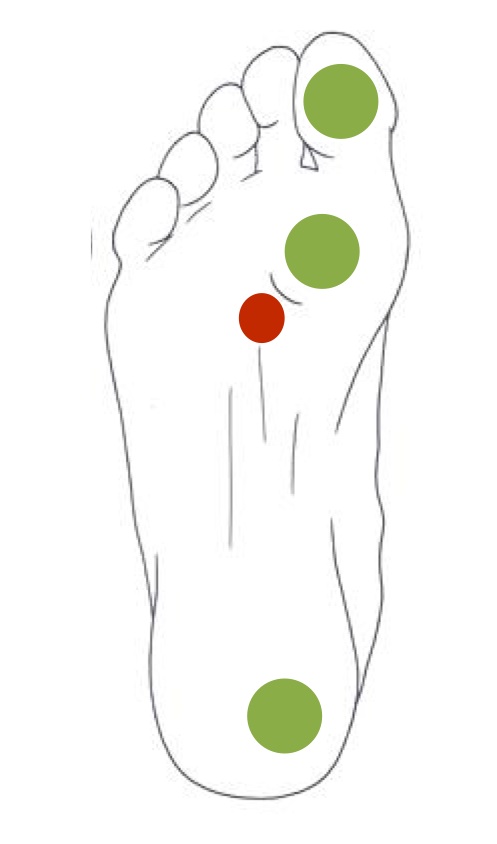
Starting with the feet. Weight on the feet should be on the big toe, the pad behind the big toe and the heel (green on the picture)  — not on the outside of the feet. The bubbling well point is just behind the big toe pad (red on the picture). At first, if you are used to spreading your weight on the outside of the feet, this seems counterintuitive. However, if you stick with it you will find it is a much more balanced position and also allows for the flow of qi from the babbling well point. Weight should be centered on the bubbling well point. When moving from one position to another, heel first, rolling to the toe, weight evenly distributed.
The the knees. Before the weight is transferred the knee needs to be "set." Then as the form changes the knee remains set and turning begins with the qua—hips area.
This involves two important aspects.
1) To move from insubstantial to substantial is not merely shifting weight from side to side, but rather a sinking, relaxing of the qua. The difference is shown on video 1.


One the basic and oft repeated taiji forms is gathering energy (see second video). It is so fundamental, yet has many layers and compexities to explore. For some time I have been using yi (mind, intention) to visualize qi flowing along the meridians in the upper body. There are twelved meridians, six yin six yang, paired three in the upper body, three beginning in the lower body. In the upper body, the Lung channel moves from the chest area along the inside of the arm ending at inside of the thumb. Its pair, Large Intestine, moves along the back of the index finger, back of the arm to the chest area. The second pair, Heart/Small Intestine,  moves from the chest area along the inside of the arm to the middle finger (inside), then down backside of the ring finger, back of arm to the chest area. The final pair Peridacrdium/Triple Warmer, moves from the chest along the inside of the arm to the little finger, then back of the little finger, back of the arm to chest area. Yi (mind) comes into play with breathing and movement. In-breath, yi moves qi down arm. Out-breath, yi moves qi along the back of the arm. With intention focussed first on fingers, you will feel a tingling sensation in teh fingers, and with practice in the whole arm. This is quite a strange feeling at first, but is an indication of the movement of qi along the meridians.