Monday, January 16, 2012

Taiji posture notes

Posture is everything. Well, if not everything a large part to get right in the early stages of taiji. It is not something that can be learned with books, or merely shown. It has to be felt.
Recently I have been working on a number of related area:

  • Qua (kwa), the area of the hips and related muscles and tendons. "Sink the hips," you will hear from a good teacher.
  • Xu/shi — substantial/insubstantial, the constant flow from one to the other, like yin and yang but not the same. Yin is inward, yang outward, yin contracting, yang expanding. Xu/shi is rather empty and full.
  • Weight on the feet.
  • Yi/mind/intention/meridians and breathing.
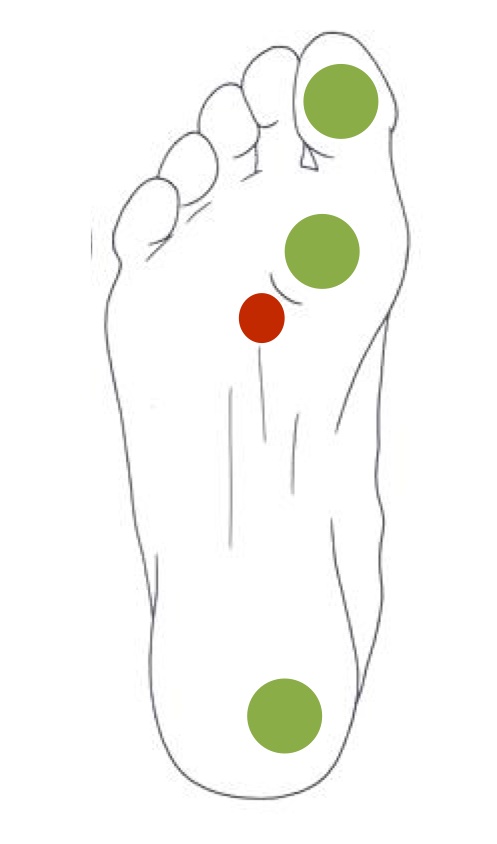
Starting with the feet. Weight on the feet should be on the big toe, the pad behind the big toe and the heel (green on the picture)  — not on the outside of the feet. The bubbling well point is just behind the big toe pad (red on the picture). At first, if you are used to spreading your weight on the outside of the feet, this seems counterintuitive. However, if you stick with it you will find it is a much more balanced position and also allows for the flow of qi from the babbling well point. Weight should be centered on the bubbling well point. When moving from one position to another, heel first, rolling to the toe, weight evenly distributed.
The the knees. Before the weight is transferred the knee needs to be "set." Then as the form changes the knee remains set and turning begins with the qua—hips area.
This involves two important aspects.
1) To move from insubstantial to substantial is not merely shifting weight from side to side, but rather a sinking, relaxing of the qua. The difference is shown on video 1.


One the basic and oft repeated taiji forms is gathering energy (see second video). It is so fundamental, yet has many layers and compexities to explore. For some time I have been using yi (mind, intention) to visualize qi flowing along the meridians in the upper body. There are twelved meridians, six yin six yang, paired three in the upper body, three beginning in the lower body. In the upper body, the Lung channel moves from the chest area along the inside of the arm ending at inside of the thumb. Its pair, Large Intestine, moves along the back of the index finger, back of the arm to the chest area. The second pair, Heart/Small Intestine,  moves from the chest area along the inside of the arm to the middle finger (inside), then down backside of the ring finger, back of arm to the chest area. The final pair Peridacrdium/Triple Warmer, moves from the chest along the inside of the arm to the little finger, then back of the little finger, back of the arm to chest area. Yi (mind) comes into play with breathing and movement. In-breath, yi moves qi down arm. Out-breath, yi moves qi along the back of the arm. With intention focussed first on fingers, you will feel a tingling sensation in teh fingers, and with practice in the whole arm. This is quite a strange feeling at first, but is an indication of the movement of qi along the meridians.


Sunday, December 11, 2011

Winter wear!

It is turning cold in the mornings now. Twenty degrees today, so time to wear the warmer taiji kit. Layering is the key. Loose layers, but lots of them. Warm as toast!

Gathering energy

Part the wild horse's mane

Single whip

Thursday, November 3, 2011

Yang Long Form

Yang Chen Fu — Ward Off
My practice since the summer has been to concentrate on the Yang Long Form (108 forms). It has been a delight and is now my daily practice.
It was daunting at first to think about learning 108 forms, but less problematic when I got down to it. Many of the forms I had already learned in Yang Short Form, and Simplified 24 Form. There are also a number of repeats during the routine. They occur like a chorus and weave into one another.
It has proved very satisfying ... more so than the short forms. I am pondering why this might be the case. Best guess is that, as the long form takes about 17-20 minutes to complete, you enter a deeper meditative state. It is also the traditional form and so I assume that the masters who designed and refined it did so for a reason.
It has also been good too to have my postures looked at and corrected by Master Jesse. He can spot issues in a second or two and the corrections he gives make so much sense. It serves to show that to have a good teacher is so important.